

When you hear “champagne country”, it certainly catches the imagination – you can envision leafy, sprawling vineyards, blue skies, and opulent wineries. While the leafy bits may be seasonal, this is all accurate. So, when we planned our trip to Reims, we knew that the two highest-priority things we wanted to do were A) visit the Reims cathedral, and B) taste some of Reims’ world-famous champagne, and perhaps do a Taittinger wine tour, or tour with one of the other champagne houses in town.
But, we had some pretty serious questions and logistics to hammer out beforehand. Good news is (spoiler!) it was all worth it!
First of all, should we visit champagne country in winter?
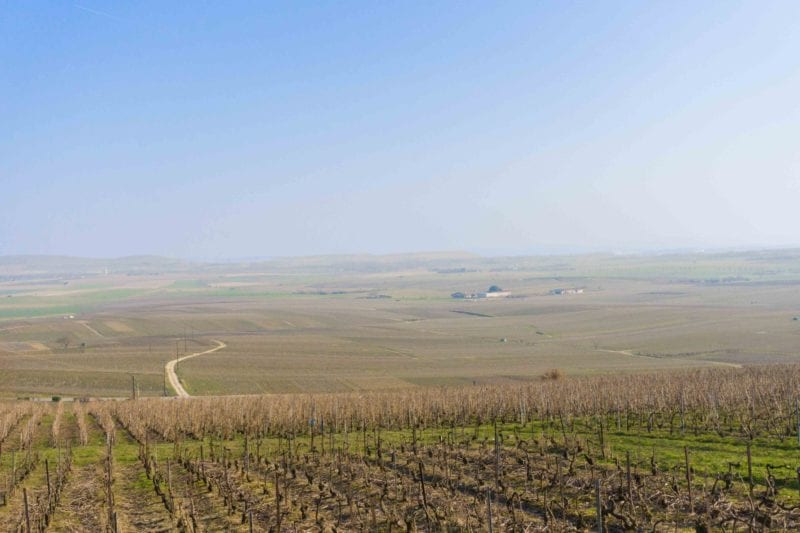
YES. It’s cold, and it’s probably going to be windy, so bring a jacket and your camera and get ready to be wowed.
Boyfriend Perspective: If you have to ask this question you should definitely go so you understand that you don’t ever have to ask this question again. It’s amazing!! Just bundle up.
How to decide which champagne house to visit

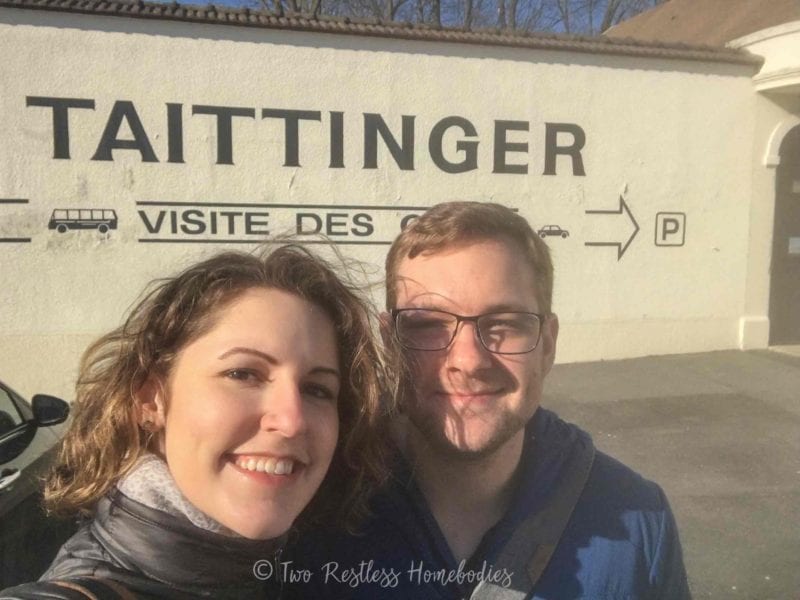
Here’s the bottom line: there is NOT a bad choice here. However, your choices include Taittinger, Mumm, Veuve Cliquot, Moet & Chandon, Pommery, Bollinger, and Ruinart (among others).
From this list, we decided to tour Taittinger (pronounced “tay-tan-zhay”) for the following reasons:
- Affordability. Touring big champagne caves isn’t necessarily cheap, but Taittinger offers one of the more affordable suites of cave tours and tastings that we found.
- Seasonality. This was perhaps the biggest deciding factor. We wanted to visit Mumm, but Mumm’s champagne caves don’t open for tours until mid-to-late March, and we planned to visit in late February. WOMP. But Taittinger was open and happy to show us around.
- History. It’s hard to find a big champagne house that doesn’t have a long history. Taittinger, in particular, dates back to the 1700s, when the founder began working closely with local monks who had discovered and refined the process of creating bubbly wines. The caves, themselves, are a part of the crayeres, or Roman chalk mines, that run under much of Reims and are certified as a UNESCO World Heritage Site.
- Notoriety. Ever walked to the champagne section of your local wine store? Most of the big champagne houses are represented. And there’s nothing quite as cool as being able to toast a celebration with a wine whose origins you’ve become very familiar with.
Boyfriend Perspective: You know, I wasn’t into wine very much – champagne even less so. Touring the house, learning the history of champagne, and tasting different types provides an education and appreciation of an art form. I also found out I have a classy palette and just hadn’t had good champagne yet. Taittinger’s Vintage and Grand Cru are delicious! I absolutely recommend getting multiple tastings with your tour so you experience the differences.
Booking a tour with Taittinger

You have three very easy options when it comes to reserving your spot and booking a champagne cave tour:
- Reserve online. Head over to taittinger.com and pick your ideal day and time. From there, choose what type of tour you’d like (basically, how much you’d like to drink after you finish walking through the crayeres), and provide your payment info, and you’re ready to go!
- Walk up. If you’re visiting in the tourist season (late spring, summer, or early fall), DEFINITELY don’t just walk up. That said, if you’re visiting in a less busy time, you can book and pay onsite during their business hours. This is what we did, and it was extremely easy.
Boyfriend Perspective: Select how many tastings you want, pay, and tour. The hostess was pleasant and spoke English, so those like me (who can’t speak French) can enjoy the tour too.
- Book with a third party. If you’d prefer to avoid planning all the logistics, there are plenty of fantastic trips to Reims from Paris and from Reims out into champagne country that will make sure you stop at the incomparable Taittinger, among other of the big champagne houses.
Getting to Taittinger


Got 30 minutes? You can probably walk from downtown Reims, near the Notre Dame cathedral, to Taittinger, in less time than that. Bonus, you’ll be very close to the Saint Remi Basilica, which you absolutely have to explore if you love stained glass and religious relics, AND you’ll quite possibly pass the oldest timber-framed house in Reims, pictured above.
You can also take a quick Uber or a taxi if you’re not feeling the mood or weather for walking. If you have a car and choose to drive, know that parking is extremely limited outside the winery, so give yourself enough time to find a spot.
Appearance-wise, don’t expect anything showy from the outside. The whitewashed exterior is very noticeable, but not ostentatious like Veuve or Pommery might be. It actually feels very modern and clean.
Boyfriend Perspective: I think the conservative exterior allows it to blend in to surrounding buildings, besides the champagne speaks for itself with exception.
The Taittinger champagne cave tour


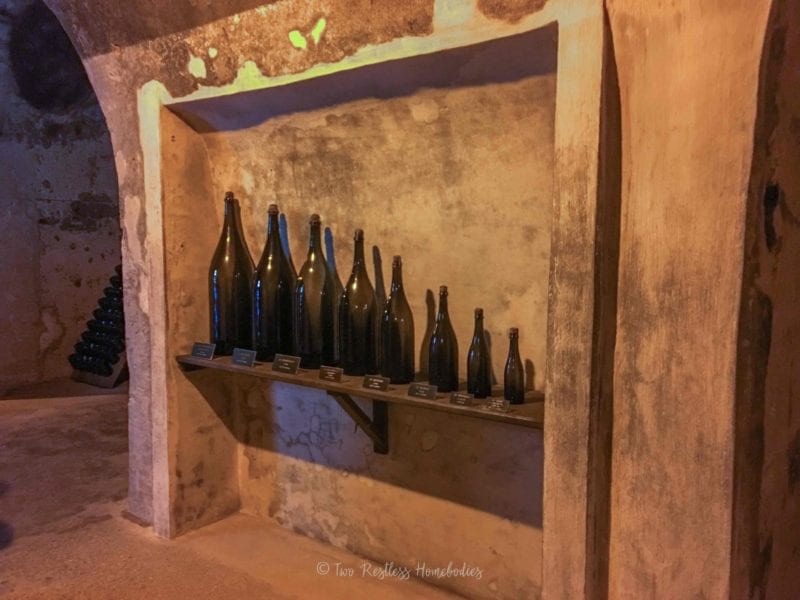
After booking, we waited in the lobby for our Taittinger wine tour to start. There, they have a beautiful wall of champagnes, and a scale replica of what the area would’ve looked like a few hundred years ago or more, when the abbey that originally occupied the site was still standing. All excellent for quick photos 😉
Then, our very glamorous tour guide ushered us into a screening room, where we got to sit in theater seats while we watched a video introduction to the Taittinger family and business. After about 15 minutes, our guide retrieved us, and led us down a spiral staircase into the caves.
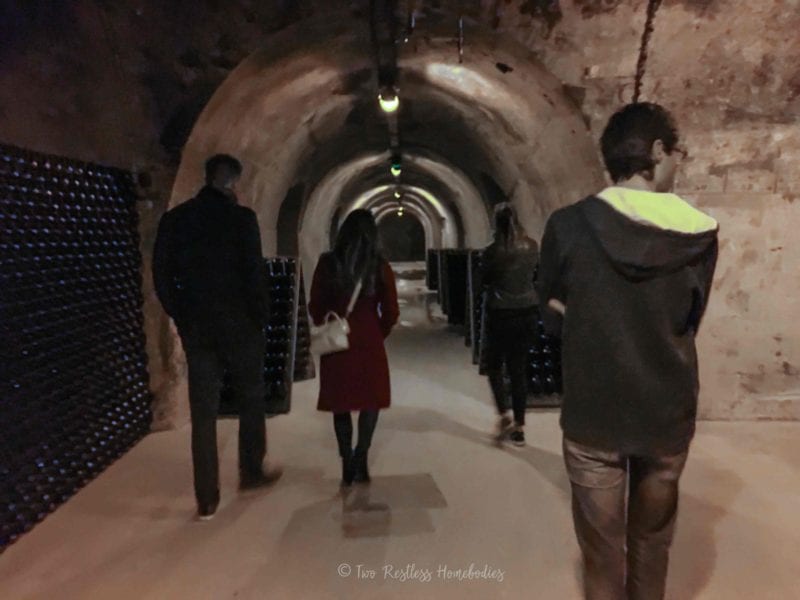
It’s worth noting that most of what are called caves are actually deep, well-supported cellars. This is where much of the wine is stored or rests. She showed us graffiti from when the caves were used as bomb shelters in the first World War, a much-older effigy to Saint Nicaise (patron saint of wine), and also showed us how the traditional wine racks work and how the bottles are manipulated so the sediment settles properly.
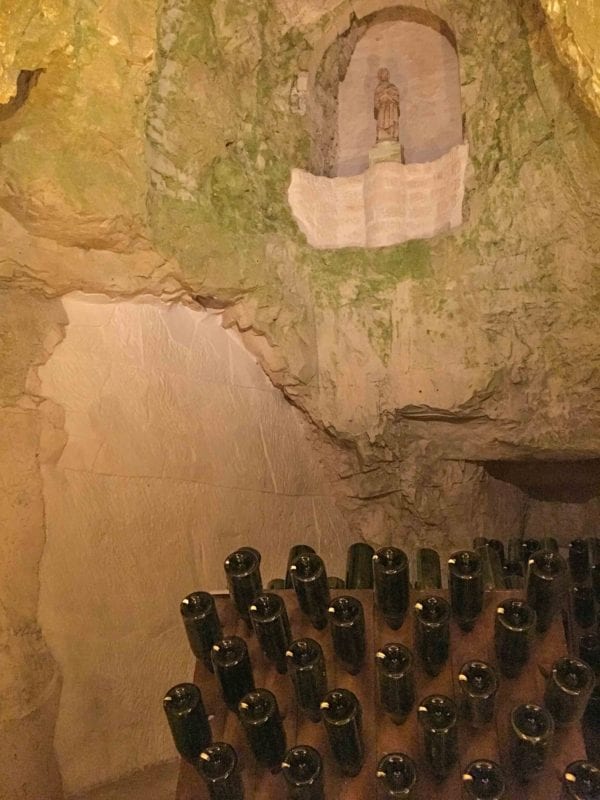


And then she led us into the crayères, themselves. While walking through underground caves is certainly dark, you can still see the chisel marks in the walls from the Roman, Benedictine, and French hands that dug out and created the form of these chalk mines over the centuries. There’s even Roman graffiti on a couple of the walls!
We ended by walking back up another spiral staircase and through the tasting room, which features an exhibit of bottles decorated by famous artists, and an exhibit of Roman and Benedictine winemaking tools found onsite.
Boyfriend Perspective: The sheer number and variations of bottles in the chalk mines was impressive, and it’s not even the largest cellar they have! O_o
Champagne tasting at Taittinger
No Taittinger wine tour would be complete without samples! When we booked, we chose the budget-friendly splurge tour called L’Instant Devoile, which provides 2-3 tastings. During the tasting, you get a great idea of what “mouthfeel” is. Frankly, I’ve always loved wine, but I wasn’t really sure what “mouthfeel” was supposed to quantify. When you’ve got bubbles of different sizes and vivacity, it makes a lot more sense – that factor completely changes the taste and experience of each wine.
Boyfriend Perspective: By this point, I’m a very happy person drinking champagne. Unsurprisingly to me, I want to upgrade for more tastings.
We also got a quick crash course in what else to look for in champagne tastes and vintages. For instance, brut is going to be the champagne you want – brut champagnes have no additional sugars outside of what’s left over from the fermentation of the grapes. It’s tart, and it’s what any self-respecting Reims citizen would drink. Demi-sec – champagne with additional sugar added – is really only produced for export to places, like the US, that have a much bigger sweet tooth.
We got to hang around the tasting counter, chatting with our guide and other visitors/tour-takers, and then finally wandered on out to walk off our tasting as we returned to town.
Final thoughts about our delightful tour of Taittinger champagne
This champagne house is beautiful, the tour is well-done, and the brand and product are steeped in an enormous amount of history. If you want to get a solid feel for one of the industries that this lovely little town has become so famous for, this is a great way to do it. Plus, you might even leave with a delightful little buzz 😉
One more final thought… book a champagne tour of Taittinger (or any other legendary champagne house) ASAP!
Have you toured a champagne house in Reims or Epernay? What did you think? Let us know in the comments!
Andddddd…. please pin for later 🙂

 Dominion RiverRock on Brown’s Island


A Taittinger wine tour sounds like an exceptional experience, Luke and Meghan. What convinced me to add this place to my bucket list is that champagne house. How long does the tour last?
The tour is a couple hours long – not bad at all, but long enough to help you feel immersed in champagne culture 🙂