

When we travel, we always enjoy trying new foods and exploring how local cultures and the foods central to them influence each other. So it should be no surprise that, since we just got back from our first trip to Barcelona, our stomachs are so sad to be back home! We took cooking classes and food tours in Barcelona, and just walked around different parts of the city looking for snacks. This means that we got a fantastic crash-course in la comida tipica catalana, or typical Catalan food. So, for anyone else who wants to get to know what to eat in Barcelona for foodies, here are our 9 must-eat foods in Barcelona.
Table of Contents
The best cured ham in the world: Jamón curado (Serrano ham vs Iberico, and Jamón Pata Negra)
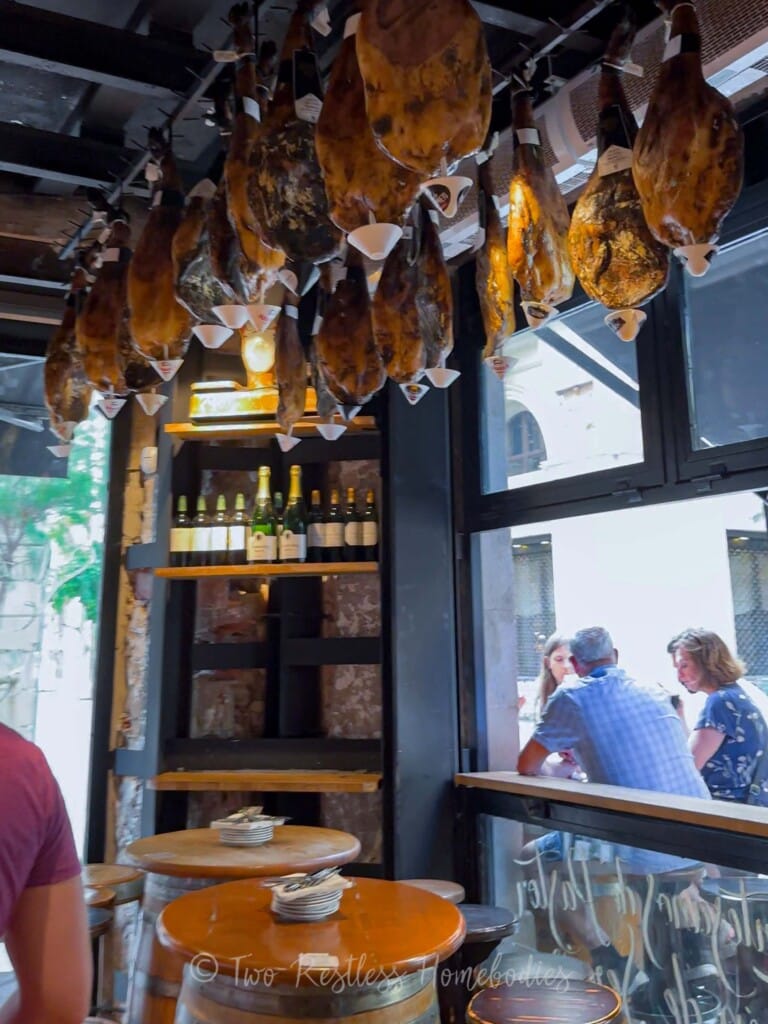

Yes, I know those are fighting words, and maybe we’ll feel differently as we continue to broaden our cured ham horizons. But for now, let us just say that these Spanish ham types have completely won our hearts. If you’re traveling to Barcelona for the first time, this is just another reason to take a food tour: you must track down some jamón curado (pronounced ”ha-MOHN koo-RAH-doe”), or Spanish cured ham. There are a couple kinds to keep an eye out for:
Serrano ham (jamón Serrano)
This is the sort of cured ham you’re likely to find at the corner market, vacuum-sealed in a refrigerated package, for a very reasonable price. It’s the type of Spanish cured meat that locals will often eat at home, and make no mistake, it’s delicious. It’s salty, smooth, and easy to eat with bread, cheese, really just about any accoutrement, as well as on its own. It comes from a variety of pig breeds, and is usually aged for over a year. This is perhaps the most accessible of the Spanish hams, and is very much a part of la comida tipica catalana.
Iberico ham (jamón Iberico de bellota)
Iberico ham is a bit more exclusive than the Serrano variety. It comes specifically from Iberico pigs, and is characterized by rich-tasting meat with a higher fat content, thanks to these pigs’ diet of predominantly acorns. And since bellota means acorn in Spanish, this is why you may see this meat referred to as Bellota ham. The price point is a bit more variable for Iberico ham but you can still easily find it in farmers markets, grocery stores, and bodegas/bars all around Barcelona.
Jamon Pata Negra (also, 5J jamón Iberico)
This isn’t technically its own category; rather, it’s the extreme high end of Iberico ham. Pata Negra (or black hoof) is a very specific type of Iberico pig, and yields one of the most expensive types of Spanish cured ham. Because this is the champagne of cured meat, you’ll want to taste it alone, letting the tender fat content melt in your mouth while you savor the nuttiness that comes from free-range pigs who spent a portion of their lives eating only acorns.
More acorn fed Iberian ham: Pluma Iberica
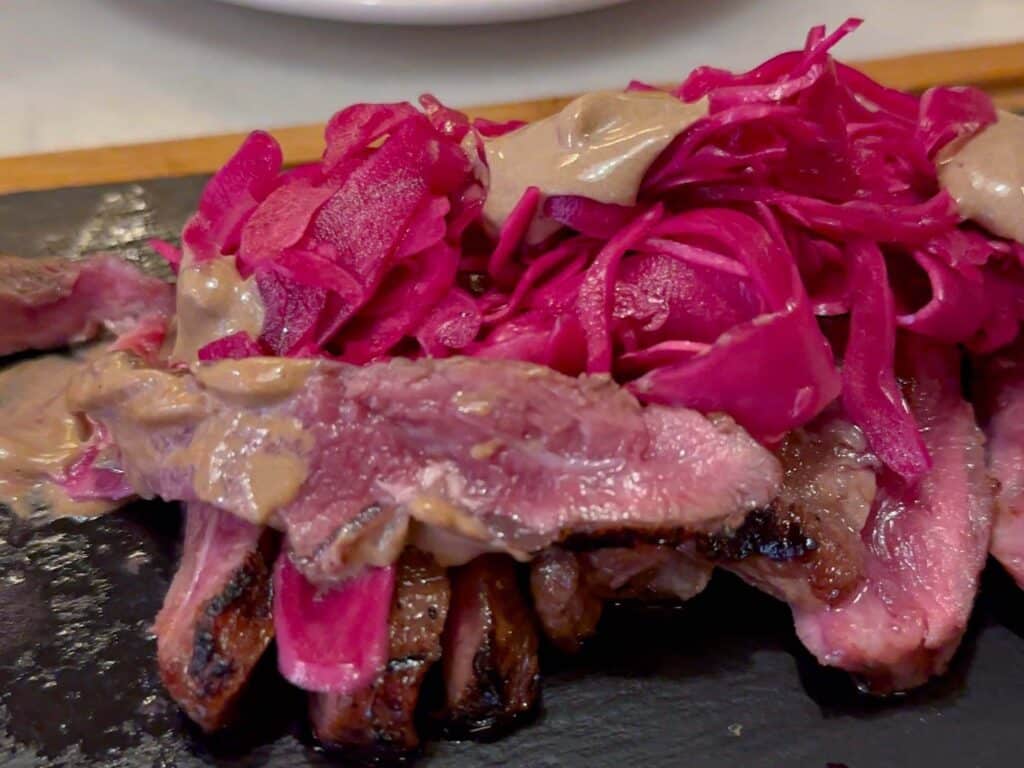
While we’re on the topic of Spanish ham, you absolutely cannot miss trying pluma iberica. This cut of pork is taken from just below the jowl of an Iberian pig (the same ones prized for their cured legs), and seared. We’re accustomed to seeing all pork products cooked well through, just like any white meat. So, when we ordered this amazing pluma iberica at Bar del Pla, we were shocked to see it seared on the outside and a surprising deep pink on the inside. Being naive Americans, I’ll admit we both did some hasty Googling to make sure it was supposed to be cooked that way (spoiler: it is), and also to confirm we hadn’t accidentally ordered beef (spoiler: we didn’t). Once we made sure this meat was what we thought it was, we both took a bite. Personally, I think Luke’s opinion says it all: “this is the best steak I’ve ever eaten, and it’s pork.” It’s tender, flavorful, juicy, and everything any meat should be. 150/10, would recommend. Also, now I’m hungry just thinking about it 😭
Pan con tomate/pan tumaca/Pa amb tomàquet: all proper names for Spanish tomato bread


If you want to live like a local, roll up to a cafe or bar for dinner around 9pm, order a couple of drinks, and some jamón and pan con tomate. Or, grab some pan con tomate for your late afternoon snack. Or… if you’re us… do both! 😂 It is the quintessential merienda (late afternoon snack) item, and probably top of the list of comida tipica catalana.
And while we’re at it, we know there are three different names up there – so which one is it?
- Pan con tomate is your typical Castilian Spanish name for Spanish tomato bread. If you order it, everyone will understand what you’re asking for with no issue, so stick with this one!
- Pa amb tomàquet is Catalan, the regional language of Catalonia, for Spanish tomato bread and sounds like “pahm toh-MAH-ket.” You probably don’t need to try to remember that 😅
- And pan tumaca is somewhere in between – after all, if you say pa amb tomàquet fast enough, you’re going to get something pretty similar to “pahn tu-MAH-ka.”
Spanish tomato bread is so simple – in fact, we made it quite easily in both of the cooking classes we took in Barcelona. Toast some bread, add fresh garlic, and then cut a tomato in half and smush the insides all over the bread. Top with salt and olive oil and you have yourself a delicacy. Is pan con tomate just bruschetta in Spanish? Maybe not, but it will have you saying “bruschetta who?” Even when my stomach decided to act up for a few days during our trip, one thing I never could say no to was Spanish tomato bread.
Obviously, you have to try paella in Barcelona


While paella may not be traditional in Barcelona – having originate further south in Valencia – it has become a staple over the last century. But since it’s no longer just a big, hearty meal for farmers, Barcelona has put its own spin on the dish: seafood paella. Think octopus, cuttlefish, squid, mussels, and clams, all mixed in with rice, saffron, and plenty of veggies and oil. And that’s exactly what we helped prepare in not one but two cooking classes in Barcelona! And while staying in the Penedes, we were even treated to a paella, homemade by a local, that included squid ink, making it a striking dark gray to the point of being almost black.
Just remember, paella isn’t considered a dinner food – no one wants to be THAT full when they head off to sleep! Instead, paella is usually eaten for lunch in the early afternoon, as lunch is usually the biggest Spanish meal of the day. And you’re more likely to see locals eating it on Thursdays or on Sundays, often with family.
How do you say (potato) omelet in Spanish? Tortilla! Or honestly, just “Spanish omelette” works, too.


Spanish tortilla is a REVELATION, and we were lucky to eat this several times and to also make it in our cooking classes in Barcelona. Spanish tortilla isn’t a thing you wrap a taco in. No, Spanish tortilla is pretty much a potato omelet. You take soft, cooked potatoes, add eggs and seasonings – and possibly other things like jamón – and cook it in a big pan like an omelette, flipping it out into a plate and then putting it back into the pan to cook on all sides. Spanish omelette can be served hot or cold, but when you sit down to a piping hot Spanish tortilla, it gives the most major comfort food vibes. And you can have tortilla for breakfast or dinner – it’s completely up to you. Though if you’re going to have a potato dish later in the day, you miiiight be more likely to see patatas bravas show up on the menu.
Speaking of which, you have to get some patatas bravas, too!

So, patatas bravas weren’t really invented in Barcelona, but the city has become sort of the Mecca for patatas bravas in Spain. This is a very simple, bar-friendly dish made up of crispy, fried potato chunks topped with a tomato-based sauce that’s sometimes creamy but always a little spicy. Every cook in Spain makes these a bit differently, especially when it comes to the sauce, so don’t be afraid to test them out everywhere you go! Order these as an appetizer to share with friends, or as a side to wash down with a beer or some tasty Spanish wine. You really can’t go wrong.
Iberian ham croquettes, or croquetas de jamón


So, there’s literally no one in the world who could say anything against breaded and fried balls of ham and cheese or bechamel sauce, right? RIGHT? 👀 We had croquetas de jamón several times throughout our stay in Barcelona, and everyone made them just a little differently. They have a lot of nostalgia for locals, because they’re something you’d often get made for you as a kid, and they could contain anything. You could have croquetas de jamón y queso, or Iberian ham croquettes, or croquetas de atún (tuna!)… any sort of leftover could easily be rolled in with that cheese or bechamel sauce and popped into the oil for a few minutes to get crispy. Then, when you bite into them (please be careful – no blistered mouths, okay?) you should get a gooey, saucy, meaty center. They’re delicious bar food, good appetizers, and could honestly be their own main course with the right sides.
Can’t forget Catalan desserts! Let’s start with crema catalana (vs creme brûlée)


The first thing you’ll notice about crema catalana – or Catalan cream – is that it’s served in a ramekin and coated on top with a layer of caramelized sugar, just like creme brûlée. However, the delicious egg custard that goes into this most famous Catalan dessert is actually flavored with citrus – specifically lemon and orange zest – and cinnamon instead of vanilla bean. This gives the smooth, sweet custard a wonderfully warm flavor that makes creme catalana best served warm. It’s an in-depth pain in the ass to make – we made this in our Barcelona cooking classes, too! – but is indisputably a fantastic, light way to wrap up a lovely meal. You can find crema catalana at just about any restaurant in or around the city, so maybe make it your mission to try a few and see which one you think is best! (And let us know, okay? We want to go back and need suggestions 👀)
The last of our Catalan desserts: Xuixos de Girona

The Catalonian xuixo – said and written “chucho” in Spanish – is actually thought to originate in Girona, just an hour or so away from Barcelona. But of course, as with all things Catalonia, xuixos also found a home in this beautiful city. Xuixos are actually a flaky pastry cylinder filled with crema catalana (yes, the exact same dessert from above, but minus the caramelized sugar), fried, and rolled in sugar. This means xuixos are gently crispy and sweet on the outside, and tangy, rich, and smooth on the inside. They’re truly a delight to eat! We found our first xuixos at La Colmena, one of the oldest bakeries in Barcelona (they also serve some truly heavenly stuffed meringues that you MUST try, but I digress). Just know that if you decide to visit La Colmena as well, their wide selection of baked goods and savory treats makes their very small storefront a very popular stop, so seeing a line out the door isn’t uncommon.
Bonus: if you’re feeling frisky, try a clara, otherwise known as a summer shandy


Okay, we didn’t directly include this on the “must try foods in Barcelona” list because it’s not specific TO Barcelona, and because it’s not really COMIDA tipica catalana. But mostly, we excluded it because we tried it… once. And I’m pretty sure we won’t try it again 😅 It’s a summer drink made 50/50 with Fanta lemonade and a regular beer, like Estrella. This shandy is light, probably very refreshing, and has a combo of tastes that neither of us could really stand. But, that said, some of the other folks on our food tour seemed to enjoy their clara, and it IS one of the most popular summer drinks in Spain. So it’s definitely worth a try for anyone with a curious palate. (And for what it’s worth, we found this CultureTrip guide to ordering beer in Spain really helpful.)
Don’t forget to pin for later!


 21 must-have things to bring on a road trip


